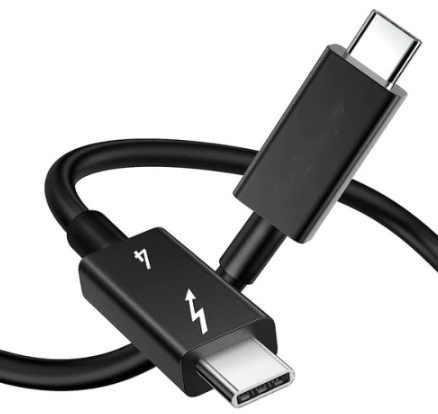
The history of the Universal Serial Bus (USB) standard dates back to 1996. It initially appeared as USB 1.0, was later superseded by 2.0, and subsequently evolved into the confusing array of 3.0, 3.1, and 3.2 specifications. Thankfully, the newest open USB specification—which leverages the technical foundation of Thunderbolt 3—has adopted the relatively concise name: USB4.
USB4's theoretical bandwidth ceiling can reach 40Gbps (actual performance depends on the manufacturer's implementation), and it includes capabilities to support DisplayPort, PCIe tunneling, and direct communication between devices.
Typically, a basic USB4 host implementation only supports a bandwidth of 20Gbps and provides only 7.5W of power delivery to connected accessories. In contrast, the more premium Thunderbolt 4 interface can provide accessory power up to 15W. USB4 is a royalty-free technology managed by the USB Implementers Forum (USB-IF), which contributes to its higher adoption rate in mid-range and budget-friendly devices.
Although the USB4 Version 2.0 specification has boosted the maximum bandwidth to a staggering 80Gbps, as of 2025, this latest version is still in the market rollout phase and has not yet achieved widespread adoption.
Several core design philosophies of USB4 include:
- Unified Port: Utilizing (and exclusively using) the USB-C port to integrate display output, data transfer, and charging/power delivery functionalities.
- Broad Compatibility: Achieving universal compatibility with existing USB and Thunderbolt products.
- Standardized Experience: Providing a predictable and consistent user experience through defined port functionalities.
- Flexible Configuration: Allowing the host system to flexibly adjust bandwidth allocation, power management, and other performance-related parameters based on specific system requirements.
Internal Differences Beneath the Similar Appearance: Thunderbolt vs. USB4
Despite USB4 originating from Thunderbolt technology, there are still several notable distinctions between the two. Thunderbolt is a high-speed connection standard jointly developed by Intel and Apple in 2011, which has since undergone continuous technological innovation. Thunderbolt 4, launched in 2020, improved upon its predecessor, Thunderbolt 3, in terms of data transfer rates, video output capabilities, and power standards. Later, in late 2023, Intel announced Thunderbolt 5, further enhancing bandwidth and overall performance. Currently, Thunderbolt 4 is widely implemented, while Thunderbolt 5 is progressively entering the high-end hardware market.
Key Features of Thunderbolt 4
Thunderbolt 4 is fully compatible with USB4 and PCIe Gen 3 standards. All officially certified cables are guaranteed to provide a stable, full 40Gbps bandwidth. This standard mandates the implementation of DMA protection features (based on Intel VT-d technology) to effectively defend against network attacks like memory snooping. In terms of power, Thunderbolt 4 supports up to 100W of USB Power Delivery, sufficient for charging laptops, while ensuring accessories receive a mini-mum of 15W of power. With support for DisplayPort 1.4, Thunderbolt 4 can easily connect two 4K resolution displays.
The Flagship Thunderbolt 5
Thunderbolt 5 builds upon all the advantages of its predecessors, achieving a massive leap: its speed reaches an incredible 80Gbps, power delivery capacity increases to 140W-240W, and it supports the faster PCIe Gen 4 standard. By integrating DisplayPort 2.1 technology, Thunderbolt 5 can drive up to three 4K displays with just one cable, significantly outperforming Thunderbolt 4. Like its predecessors, Thunderbolt 5 uses the USB-C port and maintains backward compatibility with Thunderbolt 3, Thunderbolt 4, and USB4. As of mid-2025, Thunderbolt 5 is primarily found in select high-end laptops and desktop PCs utilizing Intel Meteor Lake or newer platforms.
Interface Standard Comparison Table
To compare these standards more clearly, we have compiled the following key parameters:
| Feature |
Thunderbolt 4 |
USB4 |
| Connector Type |
USB-C |
USB-C |
| Mini-mum Supported Bandwidth |
40Gbps |
20Gbps |
| Maximum Supported Bandwidth |
40Gbps |
40Gbps |
Mini-mum Display Output Requirement
|
Dual 4K Displays |
Single Display |
| DisplayPort Tunneling |
DisplayPort 1.4a |
DisplayPort 1.4a |
| DisplayPort Alt Mode |
DisplayPort 2.0 |
DisplayPort 2.0 |
| Mini-mum Data Transfer Speed |
PCIe - 32Gpbs; USB 3.2 - 10Gpbs |
USB 3.2 - 10Gpbs |
| PCIe Support |
PCIe Gen3x4 |
Optional |
| Wake-Up Functionality |
Supported |
Optional |
| Mini-mum Power Delivery |
15W |
7.5W |
| Maximum Power Delivery |
240W |
240W |
| DMA Protection (Intel VT-d) |
Yes (Mandatory) |
No |
| USB4 Spec Compliance |
Compliant |
Compliant |
As an open standard, USB4 has garnered extensive support from virtually all major manufacturers and contemporary operating systems, so compatibility is generally not a concern. Many newly released laptops feature USB4 ports, but it is important to note that not all USB4 ports can deliver their full potential, nor can all guarantee full compatibility with Thunderbolt interfaces.
How to Make Your Choice
Ultimately, the decision on which interface standard to choose depends on your actual system requirements.
If you plan to connect two or even three high-resolution external displays, the stable and mandatory DisplayPort support offered by Thunderbolt 4 and Thunderbolt 5 will be the superior choice.
Conversely, if you rarely use numerous peripherals, especially external storage devices requiring high throughput, the relatively lower mini-mum data transfer rate and power delivery capability of USB4 might not significantly impact your usage.
Your selection should be based on prioritizing your own workflow and device connection needs.